
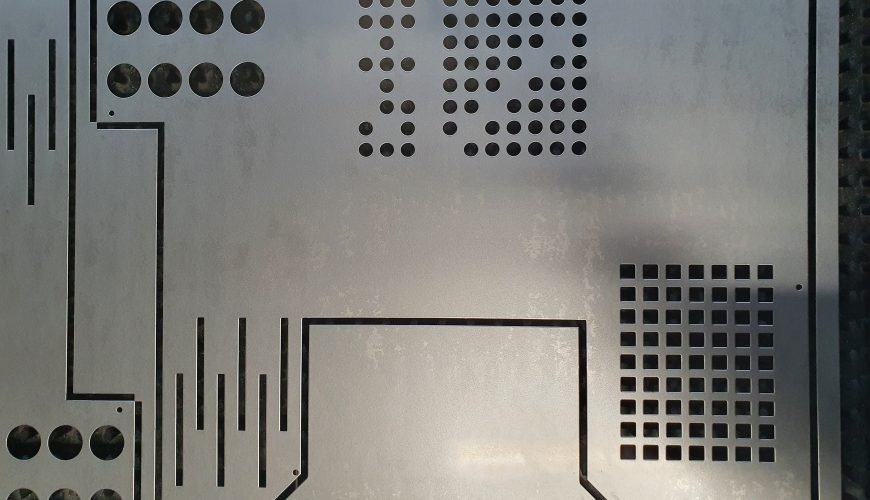
In the world of metal fabrication, precision is paramount. Whether you’re building intricate components for aerospace, robust enclosures for industrial machinery, or sleek panels for consumer electronics or conveyors, the method you choose to cut and shape your metal can dramatically impact cost, speed, and final product quality. Two titans dominate this arena: CNC Punching and Laser Cutting.
Both offer incredible accuracy and efficiency compared to traditional methods, but they achieve their results in fundamentally different ways. Understanding their strengths and weaknesses is key to making the right decision for your next project.
Case Study: A Tale of Two Technologies
Let’s imagine a scenario where a manufacturing company, “MetalWorks Innovations,” needs to produce two distinct types of metal parts:
- High-volume, standardized panels with many repetitive holes and simple cutouts for ventilation and mounting. These panels are used in server racks and electrical enclosures, requiring good structural integrity and cost-effectiveness.
- Low-volume, complex prototypes for a new medical device. These parts feature intricate geometries, very small holes, smooth contours, and require minimal material distortion.
MetalWorks Innovations has access to both advanced CNC punching machines and high-power fiber laser cutters. Which technology should they choose for each part?
Unpacking the Technologies: How They Work
CNC Punching (Computer Numerical Control Punching)
In a CNC punch press, a hydraulic or electric ram rapidly forces a hardened punch tool through a sheet of metal, creating a hole or a specific shape. The sheet material is held by clamps and precisely moved under the punching head according to a programmed path. A turret often holds multiple tools of various shapes and sizes, allowing for diverse cutouts.
Pros of CNC Punching:
- Speed for Repetitive Features: Incredibly fast for producing multiple identical holes or standard shapes (squares, circles, rectangles).
- Cost-Effective for Volume: Lower operational costs per part in high-volume production, especially for thinner materials. No expensive gases like with some lasers.
- Tooling Versatility: Can punch, notch, louver, tap, form (e.g., dimples, countersinks, small bends), and even emboss in a single setup, reducing secondary operations.
- Low Heat Distortion: Since it’s a mechanical process, heat input to the material is minimal, reducing distortion.
- Material Efficiency: Punching often allows for “nesting” parts very closely, minimizing scrap, particularly for parts with common edges.
Cons of CNC Punching:
- Tooling Costs: Initial investment in various punch and die sets can be significant.
- Limited Geometric Complexity: Restricted to the shapes of available tools. Complex curves or very intricate designs are difficult or impossible.
- Burrs: Leaves a “burr” (a small ridge of displaced metal) on one side of the cut, which may require deburring in some applications.
- Material Limitations: Not ideal for very thick materials (typically up to 6mm steel, depending on the machine) or very hard materials.
- Noise: Can be a noisy operation.
Laser Cutting
Laser cutting uses a high-power focused laser beam (often CO2 or fiber) to melt, burn, or vaporize material in its path. A stream of assist gas (like oxygen, nitrogen, or compressed air) is often used to blow away molten material and achieve a clean cut. The laser head moves precisely over the stationary or moving sheet according to CNC programming.
Pros of Laser Cutting:
- Geometric Flexibility: Can cut virtually any shape, no matter how complex or intricate, with smooth edges and tight radii. Perfect for organic shapes and detailed designs.
- No Tooling Required: Eliminates tooling costs and setup time, making it ideal for prototyping, low-volume production, and custom jobs.
- High Precision and Fine Details: Achieves extremely tight tolerances and can create very small holes and narrow kerf (cut width).
- Versatility of Materials: Capable of cutting a wider range of materials and thicknesses than punching (e.g., thicker steel, stainless steel, aluminum, even some non-metals on CO2 lasers).
- Minimal Burring: Produces a very clean edge with little to no burr, often eliminating the need for secondary deburring.
Cons of Laser Cutting:
- Slower for Repetitive Holes: For a sheet with hundreds of identical holes, a punch press will generally be faster.
- Heat Affected Zone (HAZ): The intense heat can sometimes cause a small heat-affected zone around the cut, potentially altering material properties or causing slight distortion in very thin materials.
- Higher Operational Costs: Can have higher running costs due to electricity consumption, assist gases, and more complex maintenance.
- Material Wastage: Nesting parts effectively is crucial; inefficient layouts can lead to more scrap than punching, especially with complex shapes.
- Piercing Time: Starting a cut (piercing) on thicker materials can take some time.
Back to MetalWorks Innovations: The Right Choice
Considering the pros and cons, here’s how MetalWorks Innovations would make their decision:
- For Part A (High-volume, standardized panels):
- CNC Punching
- Why: These panels have many repetitive holes and simple cutouts. A punch press can rapidly produce these features, often incorporating forming operations (like louvers or taps for mounting) in the same setup, keeping costs per part very low for high volumes. The slight burr can be tolerated or easily removed. The speed for multiple identical holes is unparalleled.
- For Part B (Low-volume, complex medical device prototypes):
- Laser Cutting
- Why: The intricate geometries, very small holes, and smooth contours demand the ultimate in flexibility and precision. Since it’s low-volume and a prototype, the absence of tooling costs for custom shapes is a huge advantage. The clean, burr-free edge is crucial for a medical device where surface finish and precision are critical. The material might also be a high-grade stainless steel that cuts beautifully with a laser.
The Verdict: It’s Not a Competition, It’s a Partnership!
Ultimately, neither CNC punching nor laser cutting is inherently “better” than the other. They are complementary technologies, each with a sweet spot.
- Choose CNC Punching when:
- You have high-volume production of parts with repetitive holes and standard features.
- You need to perform forming operations (louvers, dimples, taps) in the same process.
- Cost-effectiveness per part in mass production is a top priority for thinner to medium gauge materials.
- Choose Laser Cutting when:
- Your parts have complex, intricate geometries, tight radii, or organic shapes.
- You require very high precision and a smooth, burr-free edge.
- You’re working with thicker materials or a wide variety of materials.
- You need low-volume production, rapid prototyping, or custom parts where tooling costs would be prohibitive.
In many modern fabrication shops, you’ll find both machines working side-by-side, often even combined into a single “punch-laser combination” machine, to leverage the best of both worlds! Understanding these differences is key to optimizing your manufacturing process, saving costs, and achieving the highest quality for your metal parts.


