
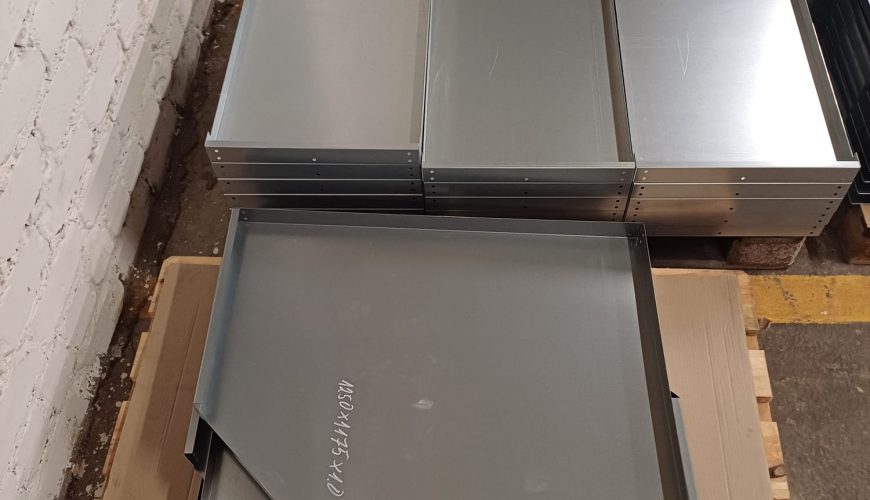
In the world of engineering, a brilliant design is only half the battle. The other half is bringing that design to life efficiently, cost-effectively, and to the highest quality standards. This is where Design for Manufacturability (DFM) comes in a crucial practice that bridges the gap between the digital drawing board and the physical workshop floor.
At Sia Kurz, we believe the best results come from partnership. We’re not just a supplier that executes an order; we are your manufacturing partner, here to help you optimize your design for success. By considering a few key DFM principles early on, you can significantly reduce production time, lower costs, and avoid potential fabrication issues down the line.
Here are five essential DFM tips for sheet metal fabrication that we share with our most successful clients.
1. Standardize Materials and Thicknesses
It can be tempting to specify a unique alloy or a non-standard sheet thickness for your part. However, sticking to standard, readily available materials and gauges offers a huge advantage.
- Why it saves money: We purchase standard materials in bulk, and they are always in stock. Sourcing non-standard materials involves longer lead times and higher purchasing costs, which directly impacts your project’s timeline and budget.
- DFM Tip: Design your parts using common grades of steel, aluminum, or stainless steel and their standard thicknesses (e.g., 1.5mm, 2mm, 3mm, etc.). If you’re unsure, ask us what materials we typically have on hand.
2. Simplify Bends and Keep Radii Consistent
Bending is a fundamental process in sheet metal fabrication, but it’s also a common area for unnecessary complexity and cost.
- Why it saves time: Every unique bend radius may require a different tooling setup on our CNC press brakes. Minimizing the number of different radii in a single part or across a project drastically reduces machine setup time. Bends that are too close to each other or to edges can also cause material deformation and require special handling.
- DFM Tip: Design with a single, standard bend radius for all bends in a part where possible. As a rule of thumb, the inside bend radius should be at least equal to the material’s thickness. Also, ensure holes and other features are kept at a safe distance from bend lines (ideally, at least 2.5x the material thickness + the bend radius).
3. Be Realistic with Tolerances
One of the biggest hidden cost drivers in fabrication is unnecessarily tight tolerances. While some features require high precision, applying the same tight tolerance to every dimension on a part dramatically increases manufacturing time and inspection costs.
- Why it saves money: Achieving extremely tight tolerances may require slower machine speeds, secondary machining operations, and more intensive quality control checks, all of which add cost.
- DFM Tip: Review your design and assign tight tolerances only to critical features, such as mating surfaces or bearing holes. For non-critical dimensions, specify more generous standard tolerances. This simple step can yield significant savings.
4. Rethink and Minimize Welding
Welding is often a necessary, but labor-intensive and costly, part of an assembly. A smart design can often minimize or simplify the amount of welding required.
- Why it saves time & money: Welding is a manual or semi-automated process that takes time. Complex welds in hard-to-reach areas increase labor costs and can introduce heat distortion, potentially requiring post-welding straightening.
- DFM Tip: Look for opportunities to use bends instead of corner welds. A single piece of sheet metal bent into a U-shape is almost always stronger and cheaper than three separate pieces welded together. If welding is necessary, ensure joints are easily accessible.
5. Optimize Holes and Cutouts
The size, shape, and placement of holes and features can impact production speed and part integrity.
- Why it saves time & material: Using standard-sized holes allows us to use standard tooling, which is faster than programming a laser to cut a custom diameter. Placing holes too close to an edge or to each other can weaken the material or cause deformation during punching or bending.
- DFM Tip: Use standard hole sizes whenever possible. Maintain a distance between holes of at least 2x the material thickness. Similarly, keep holes at least 2x the material thickness away from any edge to prevent distortion.
Beyond a Supplier: Your Manufacturing Partner
The most successful and cost-effective projects are born from collaboration. When you involve your fabrication partner early in the design stage, we can provide immediate feedback that aligns your design with the most efficient manufacturing processes.
Thinking about DFM isn’t about compromising your vision—it’s about enhancing it by ensuring the final product is as robust and economical as it is brilliant.
Ready to optimize your next design for manufacturing? Contact our team today. We’re ready to help you build something great, together!


