
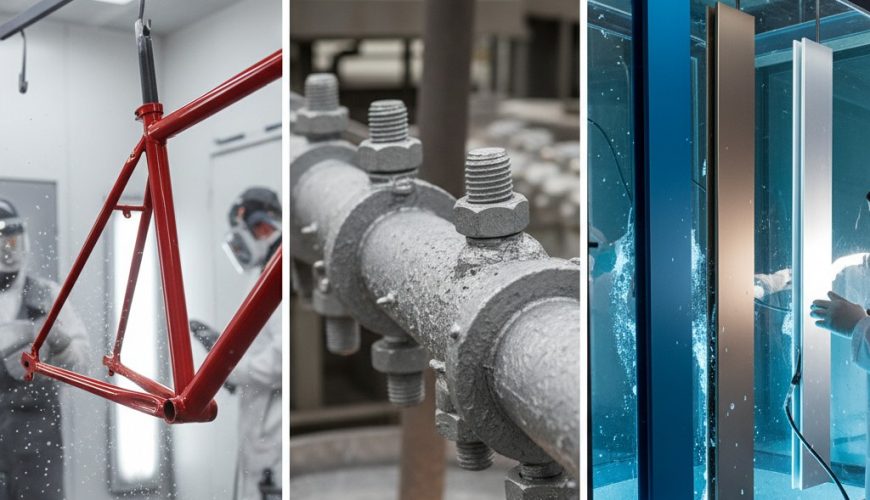
Once your metal part has been cut, bent, and welded, there’s one final, crucial step: choosing the right finish. A finish is more than just a color; it’s a shield that makes the part’s durability, lifespan, and resistance to the elements.
The decision between powder coating, galvanizing, and anodizing can be confusing. Each offers unique benefits suited for different materials and applications.
This practical guide will break down these three popular finishing methods to help you make an informed decision for your next project.
1. Powder Coating
What is it? Powder coating is a dry finishing process. A fine powder, made of polymer resin, pigments, and other additives, is applied to a metal part using an electrostatic spray gun. The charged powder particles adhere to the grounded part, which is then cured in an oven. The heat causes the powder to melt and flow into a durable, uniform “skin.”
- Best Suited For: Steel, Stainless Steel, and Aluminum. Ideal for projects where appearance and a wide range of color options are important.
- Key Advantages:
- Aesthetic Versatility: Offers a nearly limitless selection of colors, textures (smooth, matte, wrinkled), and gloss levels.
- High Durability: Creates a thick, hard finish that is more resistant to chipping, scratching, and fading than traditional wet paint.
- Environmentally Friendly: Contains no solvents and releases negligible volatile organic compounds (VOCs) into the atmosphere.
- Considerations:
- The coating adds thickness (typically 60-120 microns), which must be accounted for in parts with very tight tolerances.
2. Hot-Dip Galvanizing
What is it? Hot-dip galvanizing is a process designed for maximum corrosion protection. The steel part is thoroughly cleaned before being completely submerged in a bath of molten zinc at around 450°C. This creates a metallurgical bond between the zinc and the steel, forming a tough, multi-layered protective coating.
- Best Suited For: Steel only. Essential for outdoor structural components, agricultural equipment, trailers, and any application exposed to harsh weather, making it a popular choice for the demanding Baltic climate.
- Key Advantages:
- Unbeatable Corrosion Resistance: The zinc coating acts as a sacrificial barrier. Even if it gets scratched, the zinc will corrode first, protecting the steel underneath.
- Complete Coverage: Because the part is fully dipped, all surfaces including internal cavities, corners, and edges are completely coated.
- Extreme Toughness: The resulting finish is very hard, abrasion-resistant, and can last for decades with little to no maintenance.
- Considerations:
- The finish has an industrial, mottled silver-grey appearance. It is not a decorative finish.
- The high temperature of the zinc bath can potentially warp very thin or delicate steel parts.
- The thick coating can fill threads and small holes, which may require post-process cleaning.
3. Anodizing
What is it? Anodizing is an electrochemical process that enhances the natural protective oxide layer on the surface of aluminum. Unlike a coating that sits on top of the surface, anodizing is an integral part of the metal itself. The part is submerged in an acid electrolyte bath and an electric current is passed through it, growing the oxide layer to a specified thickness.
- Best Suited For: Aluminum only. Perfect for architectural elements, electronic enclosures, machine parts, and any application where durability and a premium metallic appearance are required.
- Key Advantages:
- Exceptional Hardness: An anodized surface is incredibly hard (harder than the aluminum itself) and highly resistant to abrasion and wear.
- Excellent Corrosion Resistance: The stable oxide layer provides a robust barrier against moisture and environmental corrosion.
- Preserves Metallic Look: Anodizing is translucent, meaning the natural luster and texture of the aluminum are preserved. The layer can also be dyed to produce a range of vibrant, fade-resistant colors.
- Considerations:
- It is exclusively for aluminum.
- The hard surface can be brittle and may crack if the part is bent or deformed after anodizing.
Quick Comparison Guide
| Feature | Powder Coating | Hot-Dip Galvanizing | Anodizing |
| Base Material | Steel, Aluminum, Stainless | Steel only | Aluminum only |
| Corrosion Protection | Good to Excellent | Superior | Excellent |
| Durability/Hardness | Very Good (chip resistant) | Superior (abrasion resistant) | Superior (very hard surface) |
| Appearance | Limitless colors/textures | Industrial silver-grey | Metallic, various colors |
| Best Use Case | Decorative parts, frames, panels | Outdoor structures, harsh environments | Premium aluminum parts, electronics |
How to Choose the Right Finish
The best choice depends on your project’s specific needs. Ask yourself these questions:
- What is my base material? (This is the first filter: steel, aluminum, or both?)
- What is the primary goal? (Is it vibrant color, maximum rust protection, or a durable metallic look?)
- What environment will the part be in? (Indoors, outdoors, near the sea, exposed to chemicals?)
Making the right decision ensures your product not only looks great but also performs flawlessly for years to come.
Have a project and need advice on the best finish? Contact the KURZ team today. We can review your design and recommend the most effective and economical solution for your needs.


